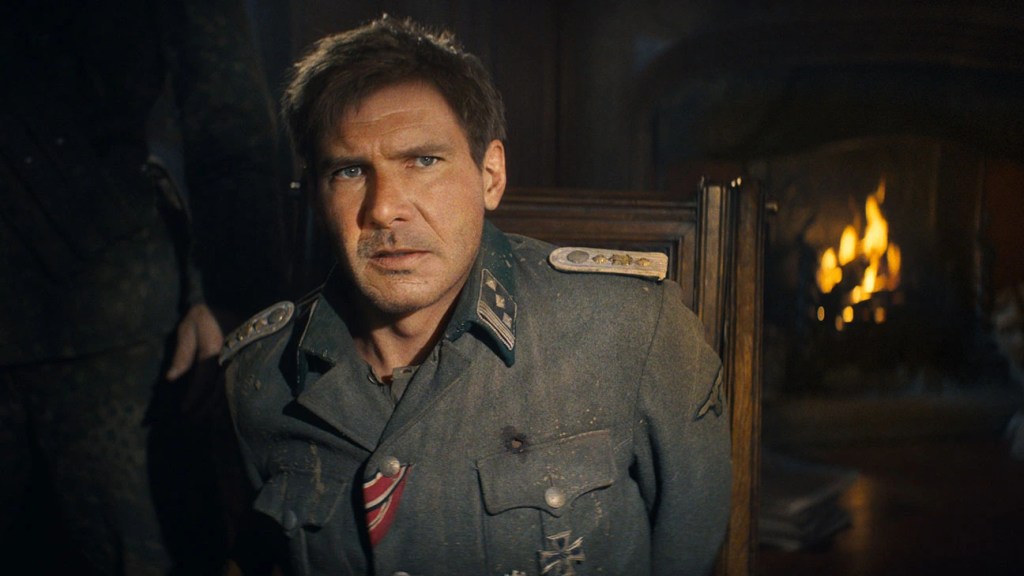
Is Indiana Jones still relevant? The character was originally conceived of as a pastiche of numerous 1930s and 1940s adventure heroes, part Humphrey Bogart in Treasure of the Sierra Madre, part Ronald Coleman in Lost Horizon. Despite these temporal allusions—themselves part of the filmic world, not the historical one—the character of Henry Jones, Junior, or “Indiana” Jones, or just plain “Indy,” is distinctly a product of nostalgia. He is not of the 1930s, but of the 1980s. Does the third decade of the 21st century really need the return of Indiana Jones? The release of Indiana Jones and the Dial of Destiny late last month (June 2023) seems to say: we’re getting Indy again whether we want him or not.
I don’t ask this easily. Thanks to a box set of the original trilogy, bought on discount at a Payless Drugs, Indy was a companion in my adolescent search for self, available any time I wanted to insert a tape into the VCR machine. I played the third film, Indiana Jones and the Last Crusade, so many times that eventually my mother would roll her eyes and say “not that again.” Yet the world of Last Crusade was an exciting, stylish one, made for the pre-pubescent that I then wished to stay. It was filled with machines—teak Chris-Craft speed boats, silvery Zeppelins, biplanes, fighter planes, tanks. Its plots were structured as constant movement between distant places—Peru, Nepal, Egypt, India, Italy, the Middle East. It was a world that stood in stark contrast with the glass block, jewel toned, postmodern malaise of my suburban reality. It was a world of high stakes hooked to esoteric mysteries from the past, a world where what and how the hero thought was as important as who and how he fought.
More broadly, Indy served as an American fantasy of self image. In two of the three original films, Raiders of the Lost Ark (1981) and Last Crusade (1989), Indy’s antagonists were Nazis. During one scene in the latter film, Indy’s father Henry (Sean Connery) calls the Nazis “the slime of humanity.” For the movie writers, the Nazis were the ideal adversary, one that could be shot, stabbed, driven over, and blown up without remorse. This is Indy as Captain America, but with a subdued palette.
Yet Indy’s Nazi adversaries were more than merely the ultimate NPC enemy. They had wider cultural ramifications. When the real Hitler had marched his armies across Central Europe, Scandinavia, and France, had bombed England from the air, and had begun to mass murder sexual, religious, and racial minorities, the United States had done nothing, maintaining political neutrality. Such policies all too often made space for Americans to give political comfort to the Nazi regime. The most visible example came in early 1939, a year after the Nazis had forcibly seized Austria, and just a month before it would repeat this “annexation” in Czechoslovakia. On February 20th of that year, more than twenty thousand American citizens filled Madison Square Garden, the most prestigious sporting venue in the most important American city. These were members of the Amerikadeutscher Volksbund, or the German-American Bund, a society of American citizens who saw no contradiction between the fascism of Nazi Germany and the future of the United States, and they put on a Nazi rally, praising Hitler and George Washington in the same breath. Elsewhere? As scholars have since established, anti-black “Jim Crow” race laws throughout the American South and West served as a legal pattern for many of the race laws Nazis crafted to justify and carry out the Holocaust. By pitting Indiana Jones against the Nazis in two of its three original, 1980s blockbusters, the historical ambivalence of Americans to the rise of Naziism was written over, is retconned. In these films, we were always the good guys, we were always on the side of the angels.
The myth of Indy the Nazi fighter became so strong that it nearly destroyed the franchise. It took more than twenty years for another film to be released, 2008’s Indiana Jones and the Kingdom of the Crystal Skull, set in 1957. For antagonists, the writers replaced the Nazis with Soviet spies. Turning Indy the anti-fascist into Indy fighter of reds under the bed was so far-fetched that the filmmakers themselves didn’t really believe in it, preposterously arming their ultimate villain, the KGB agent Irina Spalko (an ill-used Cate Blanchett) with a sword rather than a gun. Though it did relatively well at the box office, Kingdom was a muddled film, receiving mixed reactions from both critics and fans, and somehow making the racist and misogynist Temple of Doom seem better by comparison. (As ever, the petulant George Lucas told us so.) Was Kingdom an archaeological adventure like those Indy had been on so far? Or was it an homage to another Speilberg directed film, 1977’s Close Encounters of the Third Kind? Was it celebrating and leaning into Cold War red scare tropes, or making fun of them? Was Kingdom meant to be the end of Indy’s career and a springboard for his successor, his newly discovered son “Mutt” Williams (Shia LaBeouf), or to be the first of several new Indy films? Nobody, not even the filmmakers, knew what Kingdom was actually about or for—other than cashing in on the Indy intellectual property, anyway—but most of all it was an Indy film that wasn’t about fighting the Nazis, and as a consequence seemed to lack a certain spark.
The bad taste of Kingdom made me hesitant to go see Indiana Jones and the Dial of Destiny, the recently released fifth (and supposedly final) installment of the Indy franchise. As when Kingdom came out, some have wondered whether or not we needed this latest film, or wondered whether Harrison Ford (who is now eighty) was too old to play Indy. A better question: Do we need to see Indy fighting Nazis again? In 2008, the answer to this was mired only in the aesthetics of fandom. In 2023, however, there is far more salience to this question.
The answer? Nazis we get. Although Dial is set in 1969, our main villain, Doctor Voller (Mads Mikkelsen) is a Nazi… and a very Americanized one. A riff on the real Werner von Braun—the former Nazi rocket scientist who helped NASA reach the moon in 1969—Voller has distinct and bitter thoughts about the outcome of the war. As Voller tells a Black hotel steward early in the film, “You didn’t win the war. Hitler lost it.” With help from the Central Intelligence Agency, Voller sets out to struggle against Indy to recover a highly fictionalized version of Archimedes’ Antikythera mechanism, as Voller believes that this machine will enable time travel. Presumably unbeknownst to his American sponsors—we never quite get full resolution about this fact—Voller’s goal with the Antikythera is to go back in time to kill Hitler, and replace him with an actually competent Nazi leader, presumably Voller himself. The film becomes a meditation on Naziism and American complicity, with the CIA helping Voller to acquire the device, even at the cost of civilian lives.
Meanwhile, Indy finds himself fighting alone, surrounded by people who categorize his warnings about Nazis as hyperbole or paranoia. Nobody believes the Nazis are a thing anymore, even though they are right there, and everybody can see them! The only person who really understands the stakes is the eighty-year-old man who everyone thinks is a little too old and too past it to crack his whip, or ride a horse, or climb up a cave wall. As the plot unfolds, however, the companions who doubted Indy begin to see what he saw, begin to realize that, all along, the old man had been right. (If you squint hard enough, the whole film starts to resemble a commentary on the Biden 2024 presidential campaign.) Though I won’t spoil how, it should be obvious that, old as he is, and doubted as he is, Indy (with a little help from his friends) once more succeeds in defeating the Nazis, because that is simply what Indy does, it is who he is.
By the end of Dial of Destiny, we come to realize that just as the first three films were about the 1980s they were made in rather than the 1930s they were set in, Dial is about now, not the 1960s, and its main thesis is that, faced with old troubles, generational reconciliation is the way out. Despite his in-universe biography, Indy is a “boomer.” He’s had his nuclear family (wife Marian, son Mutt), he’s had the financial security of an institutional job, he has a pension and a literal gold timepiece is presented to him on his retirement. He is old and stuck in his ways and does not understand contemporary culture, he yells at neighbors to turn down their music, and he wishes he could escape the complexities of the present and immerse himself—literally—in the past. His goddaughter Helena (Phoebe Waller-Bridge), meanwhile, is the avatar of a millennial. She is single, with no home, no husband, no kids, but has fictive kin in the form of Teddie (Ethan Isidore), a teenage fellow drifter who is one part brother, one part son. Unlike Indy, Helena jumps from job to job (many of them only questionably legal), scrapes by with her wits, is comfortable with precarity, and most of all is not part of any institutional inside. She is, in other words, a gig worker. (Helena’s assertiveness is voiced in soft-peddled variations of feminist rhetoric, but it’s never clear if Helena is actually an empowered female character, or merely a totem of one installed to make the film seem more contemporary.) Helena’s in-betweenness in all things queer codes her—despite her frequent leering at male bodies of many ages—and it sets Indy on edge, making him doubt her almost incessantly. Yet, by the end of the film—in part due to Helena’s persuasive use of physical violence—she and Indy are reconciled to being on the same team, to fighting together rather than against each other and to seeing family—both born and fictive—as the site of meaning and contentment, the thing worth fighting for. Reconciliation, not relics, are the film’s real McGuffin.
What, then, does Indiana Jones and the Dial of Destiny really try to tell us? Despite the technological marvel of “de-aging” Harrison Ford for an extended opening sequence set in the thirties, and despite the trope of the titular “Dial of Destiny” that allows for time travel, the film actually argues the inverse. There is no magic. There is no going back to change the past, not for the Nazis, not for Indy, and not for us. The film ends by reuniting Indy with a wife that grieves for their lost son, with Salah and his loud, cute children, with a goddaughter who annoys the crap out of him. All Indy can fight for is all that we can fight for as well, an imperfect present and the determination to keep going, even if it gives us aches and pains.
Indiana Jones and the Dial of Destiny is not the best Indy film, nor one that I see myself watching over and over again, but it may be the most relevant Indy film ever made, replacing a fantasy of how we wish we were with a vision of how we might be.
 Harbour Fordyce